
St. Patrick Pro-Cathedral
Created a decorative design program for the historic renovation of a Gothic Revival interior
2024
Decorative Design
91 Washington Street, Newark, NJ
In progress

Project Overview
St. Patrick’s Pro-Cathedral, originally constructed in 1850 as St. Patrick’s Church in Newark, New Jersey, holds the distinction of being the first Roman Catholic church established to serve the city’s burgeoning Irish immigrant population. The church was designed in the Gothic Revival style, a popular ecclesiastical architectural movement of the 19th century, and its design is attributed to Patrick Charles Keely, a prominent Brooklyn-based architect renowned for his ecclesiastical work. Among its most notable artistic features are five murals by the internationally recognized portraitist and liturgical artist Gonippo Raggi. Additionally, the church houses a monumental 20-foot bishop’s chair, designed by John Jelliff, Newark’s most esteemed furniture and cabinetmaker during the latter half of the 19th century.
In recognition of its architectural, artistic, religious, and social significance, St. Patrick’s was added to the National Register of Historic Places in 1972.
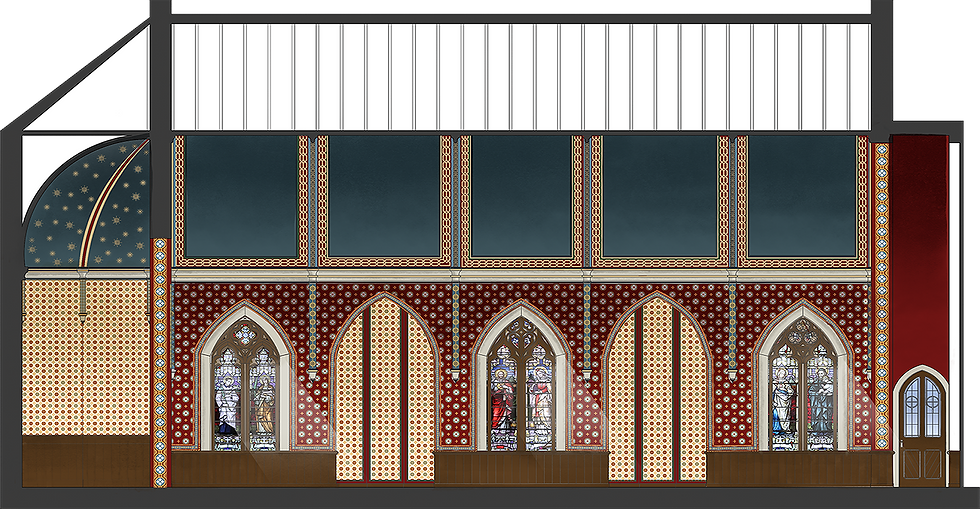
As part of a comprehensive renovation initiative led by the ecclesiastical design studio MPSB, the services of SL Design were commissioned to develop an integrated decorative design program. This collaborative project encompassed a range of restoration and design efforts, including decorative painting, plaster conservation, pew restoration, the installation of encaustic tile flooring, and the implementation of new architectural lighting. SL Design was responsible for formulating the overarching color scheme and ornamental patterns for the sanctuary, side shrines, chapel, and nave, as well as producing artistic renderings of the proposed design elements.
The design scope undertaken by SL Design emphasized the creation of liturgically meaningful decorative patterns for the sanctuary, nave, and shrine areas. These designs were intended not only to enhance the sacred character of the space but also to honor the Irish American heritage of the parish community.


Shrine of the Blessed Mother

Shrine of St. Patrick
Sanctuary Shrines
The two sanctuary shrine patterns were designed with matching patterns of interlocking gold leaf knots, alternating the monogram of the blessed mother on the left and a celtic cross on the right, bordered in burgundy and green.


Sanctuary Walls

Nave Walls
Nave & Sanctuary Walls
The Nave wall design consists of interlocking cross patterns, symbolizing eternity and interconnectedness. The Sanctuary design pairs gold medallions in an ecclesiastical chain pattern, bordering a repeating IHS monogram, also called a “ christogram,” which represents the first three letters of the Greek spelling of Jesus’ name. It is also commonly associated with the Latin phrase, “Iesus Hominum Salvator (Jesus, Savior of Mankind”)

Chapel walls

Chapel shrines
The Chapel
The chapel, situated on the left side of the church, necessitated a design program that could both stand independently and complement the patterns in the nave and sanctuary. Consistent with the colors in the former, it was decided to bring out the burgundy and use the green-blue in the accents, echoing the interlocking knotwork around the ceiling and windows. The wall pattern was simplified, composed of traditional Gothic floral and heraldic crosses.

Borders, Columns, and Pilasters
The designs for the pilasters, borders and columns throughout the church were inspired by Celtic interlacing and knotwork, which was prominent in early Christian art from the British Isles. These motifs were more than decorative, they were also imbued with deep symbolic meaning reflecting Christian theology such as the idea of eternity, the trinity, and the infinite nature of God


Encaustic Floor Tiles
The renovation also included the installation of a new flooring system utilizing encaustic tile, a traditional ceramic medium in which colored patterns are inlaid directly into the body of the tile rather than applied to the surface. This method ensures exceptional durability, allowing the decorative motifs to remain visible even after extensive wear over time. The selected tile design was developed to harmonize with the broader decorative scheme of the church, echoing the patterns and border elements found throughout the interior to create a cohesive and unified aesthetic.